



Beginner's guide
Wild Rift Beginner's Guide
Wild Rift is a 5v5 MOBA that rebuilds the PC game League of Legends for smartphones. This page walks through what you need to know for your first few games, starting from the very basics, even if you have never played a MOBA before. Detailed numbers and champion-specific information are one link away.
What is a MOBA?
A MOBA (Multiplayer Online Battle Arena) is a game genre where two teams try to destroy each other's base. Each player controls one character (a "champion" in Wild Rift), levels up during the match, and buys gear with gold to get stronger. Levels and items start from zero every match, and spending money never makes a character stronger.
Wild Rift is 5v5, and a match usually takes about 15 to 20 minutes. Built for phones, matches are shorter than on PC, and you play with a movement stick on the left and skill buttons on the right.
The map and how to win
You win by destroying the enemy Nexus in their base. Even with more kills, you lose if your Nexus falls.
Three lanes lead to the Nexus: top, middle and bottom. Each lane is guarded by turrets, and you have to destroy them in order from the front. Turrets attack nearby enemies automatically, so walking in alone is dangerous. Destroy them while your minions (soldiers that march on their own) take the hits.
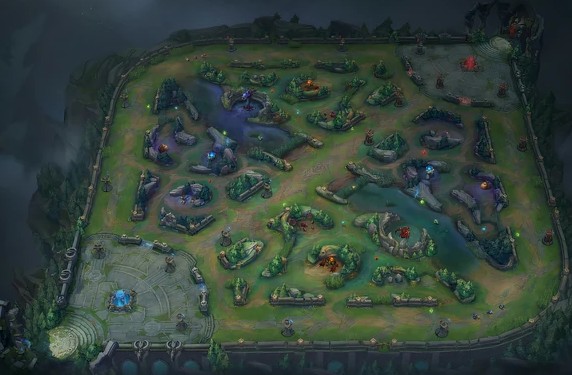 Your NexusEnemy NexusBaron LaneMid LaneDragon LaneBaronDragonBlue buffRed buff
| Structure | What it does |
|---|---|
| Outer turret | The front line of each lane. Drops plates (gold) as its health goes down |
| Inner turret | Behind the outer turret. Destroying it gives gold to the whole team |
| Inhibitor turret | The last turret of each lane. Destroying it makes strong super minions spawn in that lane |
| Nexus | Destroy it to win |
The five roles
The five players split into roles. Your role is decided before the match, so the fastest way to learn is to focus on one or two of them first.
| Role | What do they do? |
|---|---|
| Baron Lane | Fights one-on-one in the top lane. Mostly durable fighters and tanks who stay in lane for a long time and push turrets. Close to the Rift Herald and Baron Nashor. |
| Jungle | Doesn't take a lane. Grows by killing the neutral monsters between the lanes, ambushes (ganks) the lanes along the way, and leads the calls on Dragon and Baron. |
| Mid Lane | The middle lane. It is short and close to both sides of the map, so mages and assassins grow here and then help the other lanes. |
| Dragon Lane | A marksman who deals damage with basic attacks from range, laning together with the support in the bottom lane. Weak early, but becomes the main source of damage once their items come together. |
| Support | Protects the marksman in the Dragon Lane, stopping enemies and healing allies. Can do their job with little gold, which makes it an easy pick while you learn the controls. |
See the tier list for the strongest champions in each role.
Gold and items
Champions get stronger by earning gold during the match and buying items. The main sources of gold are:
- Over time: from 0:20, everyone gets 3.5 gold per second (210 per minute)
- Minions: landing the killing blow (last hit) pays much more. You still get a little just for being nearby when a minion dies, but for a melee minion it is 60 for the last hit versus 24 for being nearby, more than double
- Turrets: 150 per outer turret plate, and 75 to every teammate when a turret is destroyed
- Kills and neutral monsters: killing enemy champions and jungle monsters
Numbers as of June 2026. They may change with patches.
When do you buy items?
You can only buy items while you are in your own base (after recalling or respawning). Once you have enough gold, recall at a good moment and go shopping. A finished item costs around 3,000 gold, so buying its components along the way lets you grow stronger step by step.
If you are not sure what to buy, just follow the recommended build on each champion page. Item effects are on the items page.
Levels and skills
Champions level up with experience, up to level 15. Each level lets you rank up one skill.
- Basic skills (skills 1 to 3) have up to 4 ranks each
- The ultimate can be ranked up at levels 5, 9 and 13, for up to 3 ranks
- You unlock your ultimate at level 5, which makes it your first big power spike
For which skill to rank first, check the skill order on each champion page.
Runes and summoner spells
Runes
Extra abilities you pick before the match. You choose one keystone (the most impactful), three runes from your main tree and one from a secondary tree. The trees are Domination, Sorcery, Resolve and Precision. Using the runes listed in the recommended build is fine. See them all on the runes page.
Summoner spells
Two extra abilities with long cooldowns that you bring on top of your champion. Almost everyone takes Flash (a short-range blink) and picks the other one by role.
| Role | Common pairs (from our recommended builds) |
|---|---|
| Baron Lane | Flash + Ignite / Teleport / Barrier |
| Jungle | Flash + Smite (required for the jungle) |
| Mid Lane | Flash + Ignite |
| Dragon Lane | Flash + Heal / Exhaust / Ghost |
| Support | Flash + Heal / Ignite |
Spell effects are on the summoner spells page.
Dragon, Herald and Baron
Large monsters appear in the river, and killing them benefits your whole team. To win, these and turrets matter more than kills.
| Monster | Spawns | Reward |
|---|---|---|
| Dragon | From 4:30 | Each type makes the whole team stronger. Killing several gives an even bigger bonus (Dragon Soul) |
| Rift Herald | Early game | Can be summoned to break turrets |
| Baron Nashor | Mid game onward | Temporarily boosts the whole team's attack damage, ability power and more. A late-game turning point |
| Elder Dragon | From 18:30 | A very strong buff that often decides the late game |
Small jungle camps spawn at 0:20, and the blue and red buff monsters at 0:30. Even if you are not the jungler, thinking about where the enemy jungler might be helps you avoid ganks.
Easy champions to start with
Three low-difficulty champions per role, picked from our champion guides. Click a name for a detailed guide and the recommended build.
Baron Lane
Jungle
Mid Lane
Dragon Lane
- AsheMarksman
Her passive makes basic attacks and skills always slow, so she keeps her distance easily
- JinxMarksman
One of the strongest hypercarries (late-game DPS and range)
- Miss FortuneMarksman
Q (Double Up)'s ricochet crits and lets her chip enemies over minions
Support
Your first few games
- Play Co-op vs. AI to get used to the controls: aiming skills and last-hitting minions
- Try every skill of the champion you want to play in training mode
- Pick one role and narrow it down to two or three champions
- Play normal games and buy items exactly as the recommended build says. When in doubt, just copy it
- Once you are comfortable, look back at one reason you died (you went too far forward alone, you were not watching the enemy jungler, and so on)
Once you have a champion in mind, open its page from the champion list. It covers the recommended build, runes, skill order and how to play each matchup.